
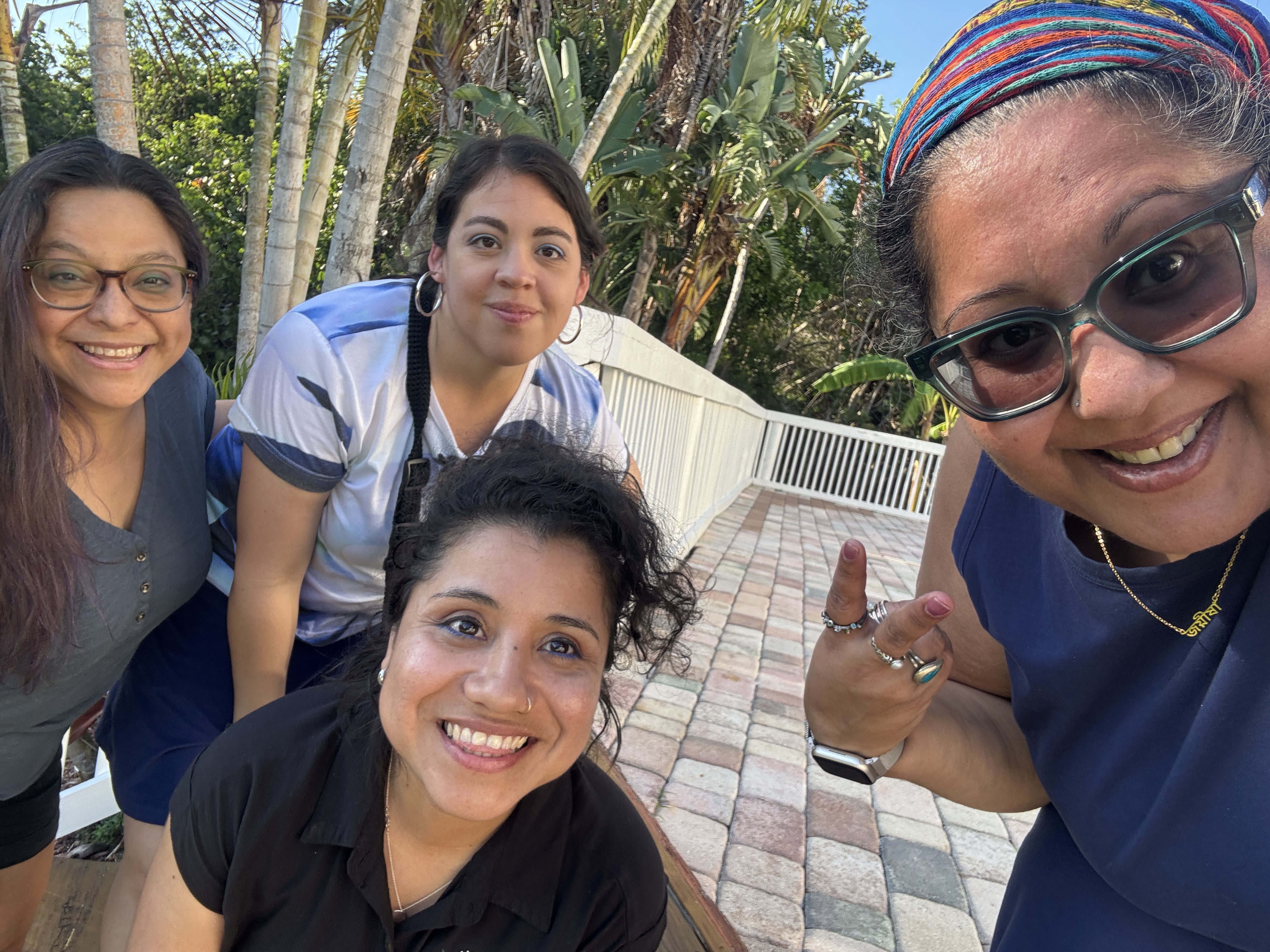

For our 2025 Another Gulf Is Possible (Another Gulf) in person gathering, we came together in Fort Pierce, Florida in mid-May to tend to Another Gulf business, enjoy each other’s company, and spend time along the Atlantic Coast, an uncommon backdrop for us. As we explored historic sites and water-shaped landscapes, we found echoes of our beautifully diverse heritages as migrants and descendants of Indigenous North Americans in every place we visited.
One of the highlights was the Zora Neale Hurston Dust Tracks Heritage Trail, which “commemorates the life and times of a world-renowned Harlem Renaissance author, anthropologist, storyteller, and dramatist,” particularly her final years spent living in Fort Pierce.
While many of us were at least somewhat familiar with Hurston’s literary and anthropological contributions, visiting her gravesite together became a meaningful moment. Those more deeply connected to her legacy shared reflections on her work, her impact, and her exquisite messiness, offering a richer understanding of Hurston’s brilliance and complexity to the rest of the group.

In her anthropological work, Zora Neale Hurston captured what remains the only known video footage of an African-born American Freedman: Kossula Oluale, also known as Cudjo Lewis. He was the last known survivor in Mobile County, Alabama, of the Clotilda—the last transatlantic slave ship to bring enslaved Africans to North America in 1860.
Kossula co-founded a remarkable community known by its inhabitants as African Town, which still exists today in the current day as Africatown, an almost entirely African American enclave straddling the cities of Mobile and Prichard. This community has become a beacon of resilience and remembrance, inspiring ongoing efforts to honor and celebrate the history of the survivors of the trans-atlantic slave trade and that of their descendants in all the depth and complexity they contain and contribute to their homes all around the world.
Zora’s documentation of Kossula’s firsthand account, posthumously published as Barracoon, has endured as the most detailed narrative of an enslaved Africans journey to America ever recorded. It is essential reading.
Likewise, the story of Africatown today is brought vividly to life in the acclaimed Netflix documentary Descendant, which offers a modern lens on legacy, justice, and cultural memory. Together, Barracoon and Descendant illuminate not just the past, but the enduring power of storytelling, survival, and truth.
Another Gulf collaborators have been direct supporters of Africatown’s environmental justice movement since it surged into broad public consciousness in 2013 with the formation of the Mobile Environmental Justice Action Coalition. Their advocacy has had a profound and positive impact on the fortunes of Africatown neighborhoods and others around the Mobile region.
During our visit, we found ourselves reflecting on how Zora, once a highly educated and celebrated author in New York City, ended up passing away in relative obscurity in Fort Pierce. We were captivated by the scandalous and fascinating details of her friendship and collaboration with Langston Hughes, especially their shared reliance on New York City-area patrons and funders. Driving along the Dust Tracks Heritage Trail and through town, we tuned into a podcast we highly recommend: Our Ancestors Were Messy. It features two lively episodes dedicated to their story, “The Pleasures and Perils of Working with Friends” and “Best Friends Forever.” It’s a must-listen for anyone who enjoys animated historical narrative podcasts with colorful characters and unexpected twists.
The journey to Zora’s final resting place took us across Florida’s Indian River Lagoon, a 121-mile-long body of water stretching between the Atlantic coast and the state’s barrier islands. Its name was adopted from the earliest Spanish explorers, who called it the Río de Ais, after the Indigenous Ais People who once thrived along its shores.
Like many of the Gulf South’s pre-colonial communities, the Ais left behind a historical record that is tragically sparse. The same destructive forces that ravaged so many Indigenous nations also reached them: disease, genocide, and the Doctrine of Discovery. Contemporary environmentalists too often diminish their histories as ones marked by a romantic “simplicity,” when in truth they reveal profoundly creative environmental adaptation and resilience.
In the littoral drifts and sea breezes, the ancient forbearers and caretakers of these places we call home still whisper truths. Languages once spoken fluently in the mouths of child and elder alike, languages like Ais, Chitimacha, and others whose names are long forgotten to most, may have slipped over the edge of extinction, but linguistic scholars are finding intriguing traces of commonality. Julian Granberry, in his studies of the Florida Indigenous Calusa language, made a striking connection: a link between the Ais language of Florida’s Atlantic coast and the Chitimacha language of the Louisiana Gulf Coast and deltas. Though this knowledge might seem like an obscure linguistic footnote, it gestures toward a deeper, almost mythic truth, an interconnected world of Indigenous lifeways and languages stretching across the Gulf long before colonization drew borders on its land and in the minds of its inhabitants.
Today, the descendants of the Chitimacha are still here. Their language, though long unspoken fluently, is being revived in the face of overwhelming odds. These efforts are courageous, but without a revolution in how we understand language transmission, they will likely never be enough. A language cannot live unless it is lived. Unless it becomes the first sound a baby hears, the daily rhythm of home, the breath of lullabies and discipline and love, it is not truly alive. Anything less is memory, not momentum.
That revival, without preverbal immersion is a slow-motion reinterment, raises uncomfortable truths about North American societies who value language diversity. To value diversity, to honor heritage, but to not support the radical, intergenerational commitments needed to sustain Indigenous or ancestral languages in the bodies of future generations is an unfortunate contradiction that speaks to style over substance. Without parents who understand the deep sacrifice and reward of raising fluent speakers of endangered Indigenous languages, without a society that treasures the sacredness of linguistic diversity, many languages may not survive this century and may not even see the second half of it.
And yet, this is precisely what makes the work of people like Zora Neale Hurston so vital and visionary. Hurston, an anthropologist and folklorist shaped by the Southern Black experience, traveled the Gulf South collecting stories, songs, and spiritual practices not because they were quaint, but because they were critical. She understood that cultural uniqueness is always under threat of erasure, always one generation away from loss. Her work now serves as a spiritual and historical lifeline for communities like Africatown, a place now fighting to retain its identity and improve its quality of life against the relentless push of industrial development and economic assimilation.
To connect the dots of language, land, memory, and resistance is to engage in profound acts of faith. It includes the sacred labor of stewarding a just transition away from the extractive fossil fuel economy undergirding so much of our Gulf South’s coastal communities toward a future built on equity, ecology, and ancestral wisdom. It is the work of those who dare to proclaim that Another Gulf Is Possible.
Because Another Gulf must be.
And while Another Gulf prioritized these meditative interventions for ourselves, we also took time to visit the famous Fort Pierce peafowl and Manatee Center destinations, because even in the most dire straits, witnessing beauty is a choice we make every day.

As we visited a park they are known to occupy en masse, a proud, properly defensive male peacock train-rattled to deter us from approaching his mate and their little fuzzy brown peachick, barely visible to the left of the larger brown peahen in the image above. In this moment—a flash of iridescence, a protective gesture, a soft call from mother to child—we were reminded that survival alone is not the goal. Life, in all its layered beauty, is what we are tasked with protecting.
 Another Gulf Is Possible/Otro GOLFO ES POSIBLE